



Gateway to STEM Education

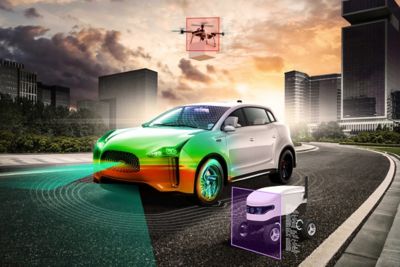
What do iPhones and 3-D printers, drones and self-driving cars, cloud computing and composites airliners all have in common? They are all man made, made by minds and hands, made by those with expertise in the fields of science, technology, engineering and mathematics. Referred to as STEM, it is the foundation for a U.S. education initiative. Yet we seem to learn daily about the coming shortage of engineers and scientists.

From corporate boardrooms and the halls of ivory towers to humble classrooms at high schools with a few dozen students, leaders in technology and education are looking for answers to the same question. How can we improve education in science, technology, engineering and mathematics?

National Robotics WeekNational Robotics Week provided us with a unique opportunity to answer this question. Development of robots is a challenging field that combines many engineering disciplines. Most robotics endeavors require knowledge of at least electrical, mechanical and software engineering. When students are exposed to robotics, they gain invaluable broad-based experience in these and other STEM fields. Continue reading

Will Student Engineers Pursue the Big Projects?

Education and engineering are in the news lately: Here is just one recent example, an article from USA Today. The line that is particularly relevant to me is that only about a third of U.S. students “who started out as engineering majors in 2005 finished that way four years later.”

When I was a college freshman in the late 1960s, I declared my major as math. I loved algebra, geometry, chemistry and physics in high school, and the subject matter and solving its problems seemed to come naturally to me. But somewhere along the line, I missed a pre-calculus course, and the Calculus 1 class I took was absolutely Greek. I stuck it out through Calculus 2, and got Cs in both classes ― but only because every morning after class, I headed directly to the professor’s office, where he tried to explain it to me all over again. It wasn’t enough. In spring of that year, I changed my major to something I felt I could master. I began my post-collegiate career as a writer, full of enthusiasm and belief that I could solve the world’s big problems. Continue reading

How to Become a Formula 1 Engineer

image of red bull racingThe Formula 1 engineer is the royal class of automotive engineering. Even the smallest improvements in aerodynamics, engine performance, traction or durability can influence a team’s success or failure. Each of the F1 teams have a large number of highly qualified engineers working on each part of the car to improve its overall performance. Where do these engineers come from? Is there a given educational path a person should follow to get a chance to work for an F1 team? Next to a sound engineering education and the right motivation and will, probably not. But there are some initiatives that are helpful on the way to the automotive engineering summit. One of them is Formula SAE/Formula Student. Continue reading

Finding Good Lectures About CFD

I thought I’d take the opportunity to discuss a request I receive on an almost weekly basis – ”where can I find good lectures about CFD”?  Of course, you can find a wealth of knowledge in good text books or attend course at great universities. However, I’d like to direct you to some wonderful materials I found on YouTube! This series of lectures is given by Prof. Lorena A. Barba, assistant professor at the Boston University (Prof. Barba has a Ph.D. from the California Institute of Technology).

This is really a nice series of high-quality lectures that will teach you everything need to know about CFD. A big thanks to Prof. Barba to make the lectures available for free on YouTube!

But the next obvious question is – ”How do I use this? How do I code it?”

Continue reading

Simulation and Engineering: State of the Art?

In conversations with work colleagues, we often discuss and debate the question, “What constitutes a state-of-the-art simulation tool?” Having worked in the simulation world for 25 years, I say that the time for a “state-of-the-art simulation tool” has passed. I now answer anyone who asks me, “It is not a tool that represents the state of the art but, rather, a methodology.”

There are many tools that simulate various things, and many of them are quite good. For example, I am firmly convinced that ANSYS HFSS represents the gold standard of 3-D computational electromagnetic simulation tools. However, this is simply one tool in a bag of tools used by engineers; individual tools by themselves do not represent the state of  the art in simulation.

Continue reading