





Software Tools for the Development of Embedded Code

In today’s ultra-competitive environment, product differentiation increasingly depends on embedded software. From automobiles to airplanes to medical devices, systems architecture and embedded software are important parts of product development cycles. Being able to manage these processes effectively so that you get the desired results is becoming a differentiator.

Today, the cars that we drive have more that 10 million lines of code! Can you imagine the hours it takes to come up with the definitions of what the car should do and how it should do it — let alone implement all this correctly through software code? It’s a time-consuming process, and getting it right the first time is challenging. We’ve all seen examples of what happens when the code isn’t correct. Incorrect code can cost companies millions of dollars, and more importantly, it erodes customers’ trust in that brand.

By using model-based, production-proven software tools for the development of embedded code, products can be developed in a faster and safer manner. And, when coupled with a certified automatic code generator, compliance for standards like DO-178B/C in aerospace, ISO 26262 in automotive and EN 50128 in rail is more rapidly achieved. Continue reading

The Physics of Split-Second Events: Explicit Dynamics

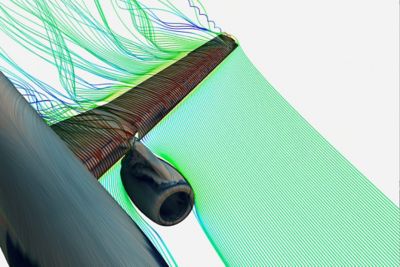
What happens when a bird runs into a plane while the plane is soaring through the air? How do you identify exactly what happened in that split second? And since every action has a reaction, how do you determine if the plane is designed to survive a bird strike? Understanding the physics of split-second events: This is the arena of explicit dynamics analysis.

Now consider split-second impacts in golf. United States Golf Association specifications regulate the speed limit with which a golf ball leaves the face of a driver. Using a standard of approximately 109 mph clubhead speed, approved golf balls leave the face of the driver at about 180 mph on average. If you’re charged with designing balls and clubs, how do you get to the optimal design that meets specs?

Animation courtesy Advanced International Multitech Co., Ltd. Continue reading

Automotive Simulation World Congress: Call for Presentations

On October 29 through 30, 2013, ANSYS once again hosts the Automotive Simulation World Congress (ASWC).

As I announced at the 2012 ASWC held in Detroit in October 2012, the event is an annual international conference that rotates across the three major regions of the world — the Americas, Europe and Asia. Slated to move from the Americas to Europe this year, the ASWC will be held in Frankfurt, Germany at the Steigenberger Airport Hotel, with an evening event at Klassikstadt.

This international event focuses on advances in simulation technology applied to the ground transportation industry, which includes car, light truck, heavy truck, bus, off-highway, agricultural, motorsport, railway and two-wheeler segments. Continue reading

Designing the Body of the Car for Maximum Fuel Efficiency

As we continue our 54.5 by 2025 blog series, we turn our attention to designing the body of the car for maximum fuel efficiency.

infographic section fuel efficiency and the bod of the car

Click Image to See Full Infographic

The body of the car provides two major opportunities for improving fuel efficiency:

  1. Reducing overall weight
  2. Improving aerodynamics to reduce drag

Much design work and ingenuity is required to reduce a car’s overall weight, and many interesting advances have been made in the field, such as the use of composites materials. Considering that car manufacturers have been working on streamlining and designing aerodynamics since the time of the Model T, we now need fresh ways to approach the issue.

The question is: What will be the most effective innovation, or combination of innovations, for the future?

Reduce weight by designing composites effectively

Replacing steel with light, strong and durable composites materials is one possible way of reducing weight in new automobiles. But the process has its challenges. Continue reading

Designing to Meet 54.5 mpg by 2025 – Fuel Efficiency Infographic

While the auto engineering industry is undergoing a large breadth of innovation (autonomous vehicles, dashboard apps to help the driver use less fuel and drive more safely), the ambitious goal of 54.5 mpg by 2025 will require car manufacturers to focus on the fundamentals of existing technologies, such as engines, transmissions and aerodynamics.

Surely, 54.5 mpg is entirely achievable, but it is a daunting goal that will require auto makers to drastically ramp up their engineering efforts. And while 2025 seems far away, it will be difficult to finish all the necessary engineering by that time if engineers progress at today’s rate. Accelerating engineering is the burning need of the day — and of the next decade — and it can only be accomplished by taking full advantage of advanced engineering tools such as simulation. Continue reading

EMI/EMC Induced Automotive System Failure

Mention of EMI/EMC-induced automotive system failure in the press last week coincided with one of the bigger technical conferences held annually in Silicon Valley – DesignCon. It was in this conference two years ago that we organized a workshop on chip–package–system simulation methodologies specifically as they pertain to EMI/EMC analysis.

Electromagnetic interference, coupling and susceptibility are complex topics. To predict such an event or occurrence requires design teams separated by organizational boundaries to collaborate effectively “outside” the silos they reside in. An automotive system design company working on the next-generation air-bag control system will be responsible for designing the printed circuit board (PCB) to meet stringent performance, reliability and cost metrics. Its teams typically perform numerous simulations to ensure that the board, by itself, meets the requirements outlined for the team. However, PCBs are passive electrically. They (along with the cables) radiate only when the integrated circuit (IC) that is present on these PCBs performs the necessary operations and generates current flow through the various traces. Continue reading

Webinar Series: Recent Advances in Automotive Simulation

automotive-leadersYou may recall that back in October the Automotive Simulation World Congress took place in Detroit. Automakers and suppliers gathered there to discuss how the global supply chain increasingly relies on single-physics and multiphysics simulation solutions, for both component and systems-level analysis. Application discussions ranged from aerodynamics, underhood thermal management, IC engine, transmission, brakes, and chassis components to the entire electric powertrain including battery, traction motor and power electronics.

The discussion continues in our ongoing webinar series named “Recent Advances in Automotive Simulation,” during which speakers share the latest advances in automotive-specific solutions that allow companies to thoroughly explore design alternatives under
varied, real-life load conditions early in the design cycle.

Please join us by registering for one or all of the webinars. Continue reading

Four Out of Top Six F1 Racing Teams Powered by ANSYS

image of Red Bull Race Team

Team Red Bull Racing poses for the end of season team photo during previews for the Formula One Grand Prix of Brazil at Autodromo Carlos Pace on November 22, 2012 in Sao Paulo, Brazil. (Photo by Vladimir Rys)

If you’re like me — a passionate fan of Formula 1 — you were probably on the edge of your seat during the last race of the season in Brazil, during which either the Red Bull of Sebastian Vettel or the Ferrari of Fernando Alonso could have won the championship. After a season of 20 F1 races, the fact that the contest was so close is a measure of the margins these teams work with. Anyone who has been to a race and witnessed these race cars firsthand knows exactly how close to the edge the cars and drivers are.

F1 Vehicles Most Technologically Advanced

F1 vehicles are the most technologically advanced in the world; they need to adapt each year to changing regulations. This often results in a team redesigning the car’s roughly 4,000 components to meet the demands of performance and safety. But not only that, engineering teams are continually improving performance between races — often having only two weeks between races to make a performance impact. With lap times for the leading cars differing by fractions of a second, improperly executing these changes from one circuit to the next can be the difference between being on the podium and not scoring any points. Continue reading